The most common mistake I see is sending more proposals when replies dry up. Freelancers spend more Connects and blame the clients. The problem usually sits in the profile, which decides whether Upwork shows you to anyone at all. Proposals only work once the profile gives both the algorithm and the client a reason to pick you.
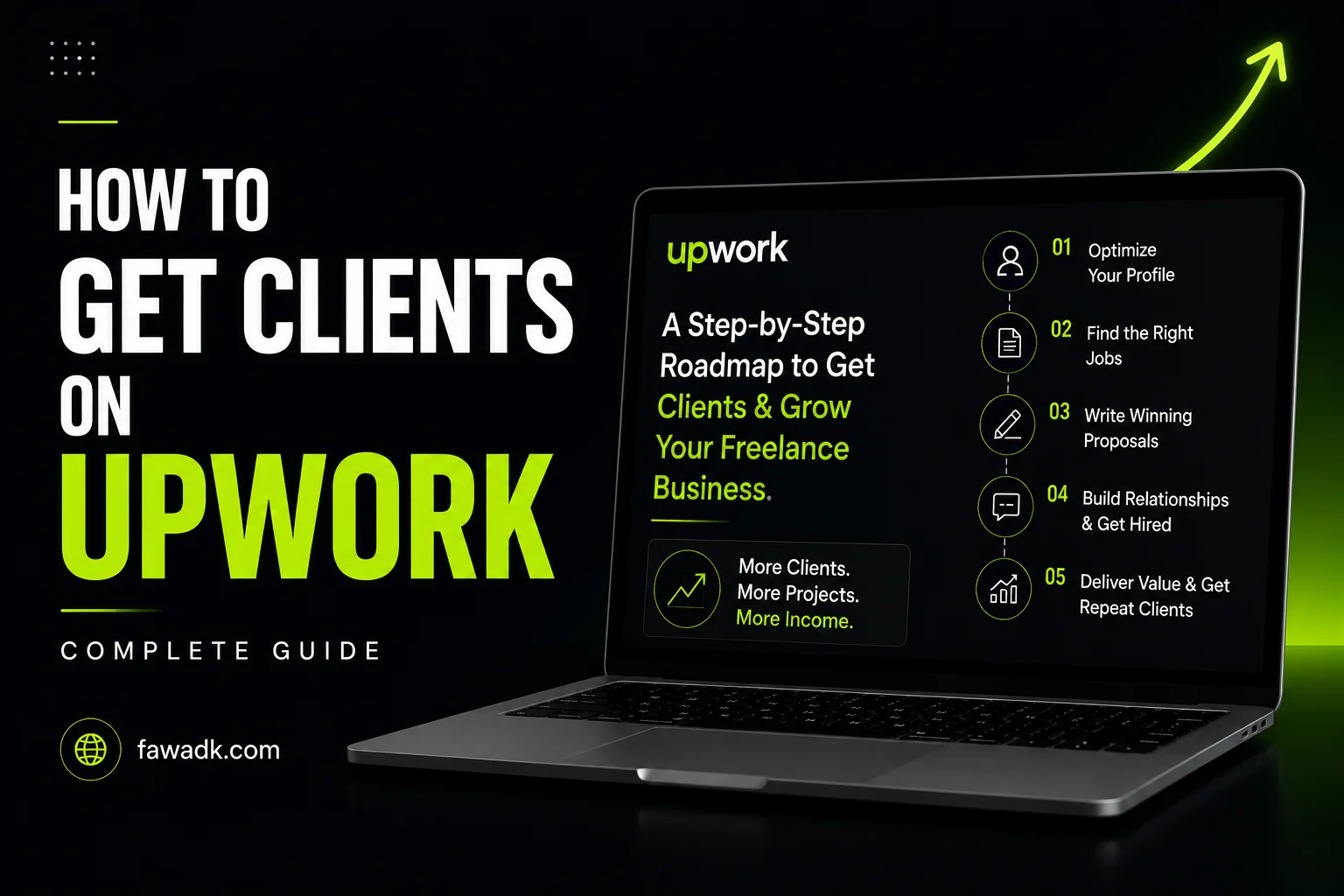
To get clients on Upwork, you need a niche profile that ranks in Upwork search and proposals that open with the client's problem. A job filter then keeps you from spending Connects on weak listings. Fix them in that order, because each step depends on the one before it.
I'm Fawad Khan, a Top Rated Plus consultant with a 98% Job Success Score (JSS) and 300+ clients. This guide covers the order I follow, from niche to proposal, and the points where it usually breaks.
Key takeaways
Foundation
What Does It Take to Get Clients on Upwork?
Getting clients on Upwork means being found in search, being invited, or winning a proposal, and all three depend on a clear niche.
" Upwork works like a search engine before it works like a job board. A client types a need, and Upwork decides which profiles to surface."
If your Upwork profile title lists five services, Upwork has no single niche to place you in, so you rank weakly for all of them. A broad title lowers how often Upwork matches you to a client's search, so invitations fall.
There are two discovery channels. Proposals are outbound and cost Connects. Invitations are inbound and cost nothing. Invitation count is not an official Upwork metric, but I use it as a health check on the profile.
I have seen a freelancer send 300 proposals over three months and get a 2% reply rate. They then fixed the profile title and niche, and invitations started arriving within two weeks. The proposals did not change by a single word.
Upwork's Job Success Score (JSS) is a rating built from client feedback, contract outcomes and long-term client relationships, not from how polished your profile looks. The Upwork Help Center calls 90% or above excellent and says scores below 79% can make winning new projects harder. A higher JSS also helps your profile rank in search and attract invitations.
Why It Fails
Why Do Most Freelancers Struggle to Get Clients on Upwork?
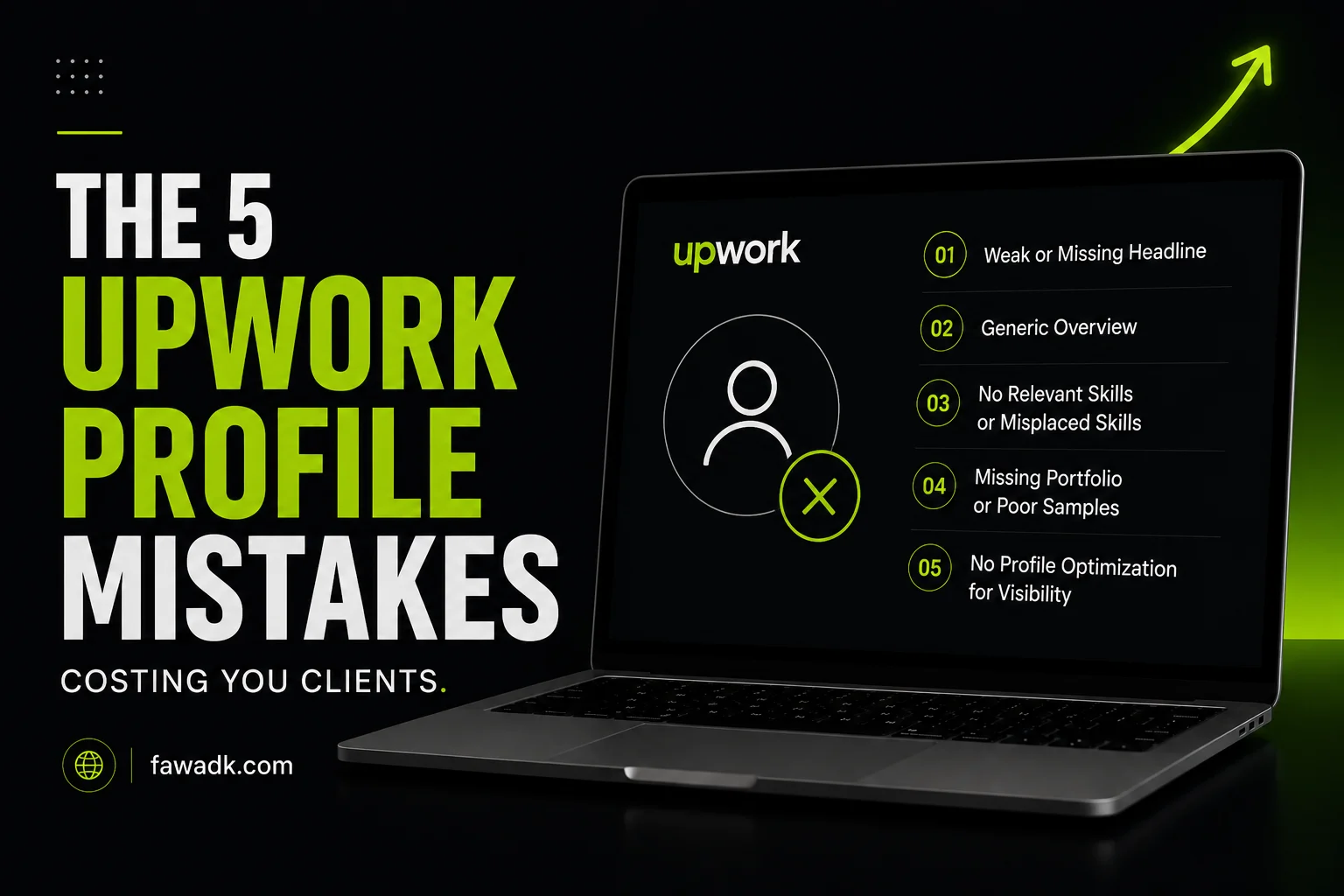
I've audited hundreds of profiles. Most freelancers struggle to get clients on Upwork because their title, overview and proposals describe the freelancer instead of the client's problem. I see the same five errors in most accounts I audit.
✗ The title claims too much
A title like "Developer | Designer | Writer | SEO Expert" gives Upwork search nothing specific to rank. Covering five services means ranking weakly for all of them.
✗ The overview opens with the freelancer
"I am a passionate professional with 8 years of experience" opens most overviews I audit. A client arrives with a problem and scans for proof you have solved it.
✗ There is no niche
Saying you do everything reads as low confidence. A WordPress developer who serves only healthcare companies still has a large market and far fewer rivals.
✗ Proposal personalization stops at the name
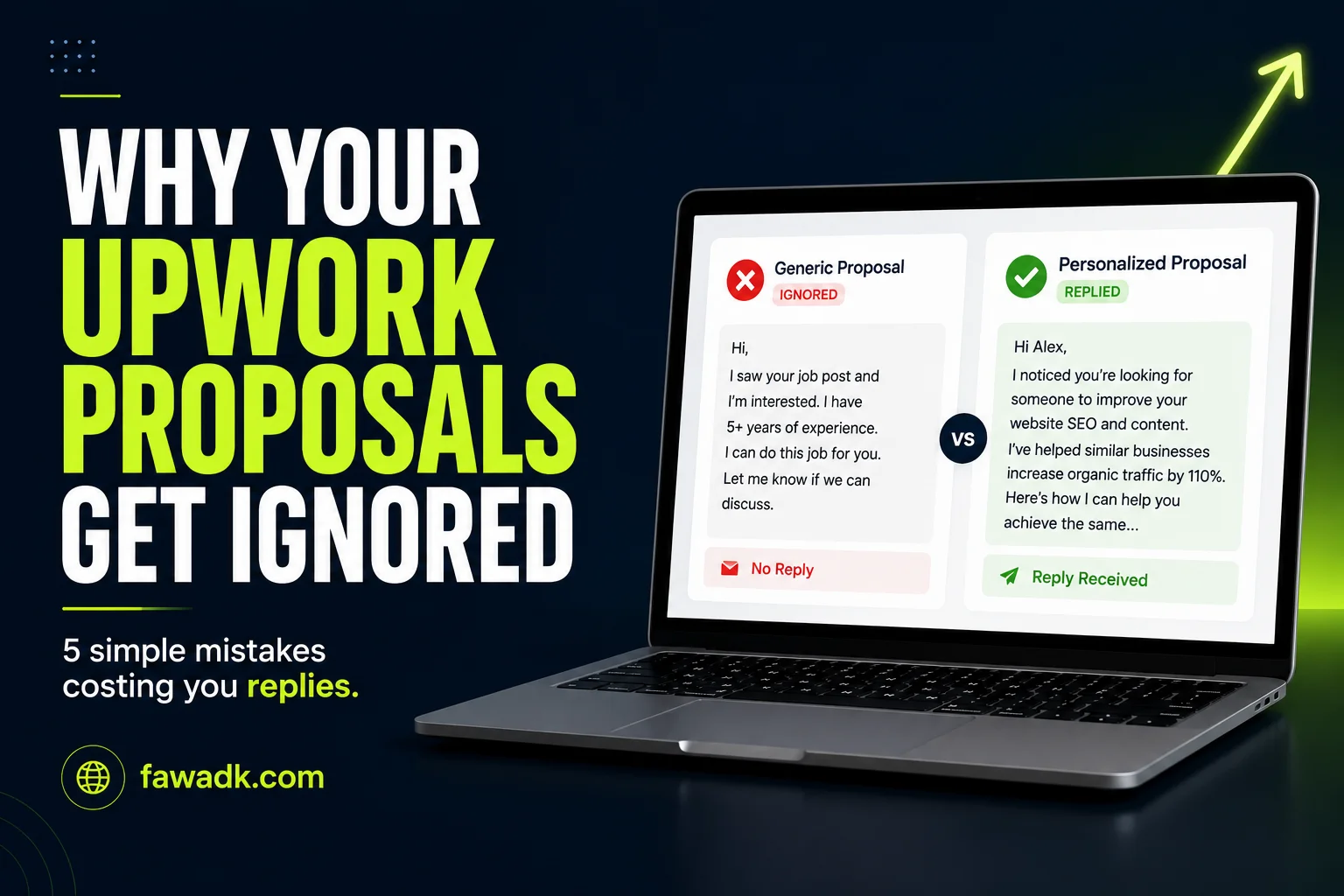
A client reviewing a stack of proposals spots a template within two sentences. When your opening paragraph fits any job post, your reply rate falls.
✗ JSS gets attention too late
Most freelancers check their JSS only after it drops. Protecting it from the first contract is easier than rebuilding it.
All five trace back to one habit. The profile and proposals talk about the freelancer, when the client only wants to know whether their problem will get solved. Narrowing your niche feels like turning work away, yet it usually removes rivals faster than it removes clients.
The System
Step-by-Step Framework for Landing Upwork Clients
1
Choose a niche narrow enough to rank.
Decide what you sell and to whom before touching the profile. "Web developer" is too wide for Upwork search to place you. "Shopify developer for apparel brands" gives the algorithm a specific match and gives clients an instant yes or no.
2
Write a profile title that does one job.
Name one service and the client type it serves. "B2B SaaS Content Writer for Case Studies and Long-Form Articles" targets narrower searches than "Freelance Writer and Content Creator" and tells a client at a glance who it is for. Every extra service you add weakens both ranking and conversion.
3
Open the overview with the client's problem.
Clients read the first two lines before deciding to continue. Lead with the problem you solve, such as "Most agencies I work with have strong delivery and a weak pipeline. That gap is my job." I keep overviews under 250 words, which is my own habit and not an Upwork rule.
4
Filter jobs before spending Connects.
Connects are the tokens Upwork uses for proposals and Boosted Proposals. The cost shows on the job post before you submit. Check these first:
My personal cut-offs are at least three past hires and under 20 proposals. Those are my filters, not Upwork rules.
5
Apply early on strong jobs.
In my experience, the first hours after posting matter most, and checking Upwork twice a day misses that window. Speed never replaces a good match, but it gets a good match seen. Upwork Job Alerts is the service I built around this problem.
5
Open every proposal with the client's problem.
Your cover letter is what a client reads before deciding whether to open an interview, so its first sentence should prove you read the post. Refer to one specific detail, such as "You mentioned mobile visitors drop at checkout. That is a fixable conversion issue." If replies stay low after that, read why Upwork proposals get ignored.
Try it now: fix your title in 3 minutes
Use this formula: [Specific service] for [client type] | [what you deliver]. The examples below are illustrative, so swap in your own niche.
Before
Web Developer | WordPress | Shopify | PHP
Graphic Designer and Video Editor
Virtual Assistant | Admin | Data Entry
After
Shopify Developer for Apparel Brands | Checkout and Speed Fixes
Brand Identity Designer for B2B SaaS Startups
Executive Assistant for Real Estate Teams | Inbox and Calendar
Do this today
New accounts
How Do You Get Your First Upwork Client With No Reviews?
With no reviews, you win a first Upwork client by making the risk look small and the fit look obvious. Reviews are the usual proof, so you need other proof that is easy to scan.
Start with a narrow niche and a title that names it. Then pick first jobs where your sample work matches the post, from clients with verified payment and past hires. Those jobs tend to carry less risk for you too.
Open the proposal with the client's problem and one concrete idea for the first step. A small, clearly scoped first job helps, because one finished contract with feedback gives the next client something to read. This is my approach, not a guarantee.
Guides online quote anything from two weeks to six weeks for a first client, and none show data. So I give no number. Upwork's guidance adds that the Rising Talent badge shows on your profile, proposals and Project Catalog projects, which gives new accounts early trust.
Connects
Are Boosted Proposals Worth Your Connects?
Boosted Proposals are worth it only on strong-fit jobs, because Upwork does not refund the standard Connects used to submit a proposal.
The Upwork Help Center describes a boost as a bid of extra Connects on top of the Connects the job requires. You can bid only if you are eligible, and eligibility depends on how well you match the job and client requirements.
My rule is simple. Read the Connects cost on the post, then ask whether the job fits your niche, portfolio and recent work. If it does, a boost can make sense. If you hesitate, skip the boost and probably the job.
Real Example
What a Real Fix Looks Like
Case: content writer, 5 months on Upwork, 3% reply rate, no active contracts.
She came to me with a 73% JSS. Her title read "Content Writer | Blog Posts | SEO | Copywriting | Email", which is four services and no specialization. Her proposals opened with "I am a passionate writer with 6 years of experience.
"I changed three things. The title became "B2B SaaS Content Writer | Long-Form and Case Studies". The overview now opened with the client's pipeline problem. Every proposal started with something specific from the job post.
Nothing about her skill changed. The positioning and targeting were wrong.
3% → 16%
Reply Rate
$2,300/mo
New Retainers
5 weeks
Timeframe
Comparison
What Most Freelancers Do vs. What Works
Which Upwork Habits Help and Which Hurt?
Broad profile title listing all services
Overview opens with years of experience
Apply to every relevant job post
Proposals open with freelancer background
Set low rates to compete on price
Check Upwork twice a day
What works better
Title names one service and one client type
Overview opens with the client's problem
Apply only to jobs meeting all 5 quality filters
Proposals open with one specific client detail
Set mid-market rates, compete on relevance
Uses real-time job alerts
Advanced
What Most Upwork Guides Skip
Most guides skip the signals Upwork gives you before a proposal ever fails: invitations, JSS timing and the Rising Talent badge. Invitations tell you whether Upwork places your profile correctly, and most guides never mention them. If they fall over two to three weeks while your proposal activity stays steady, refresh the title, overview or skills before buying more
Connects.JSS has a timing detail too. The Help Center says Upwork updates the score daily and considers contracts over 6, 12 and 24 month windows. One older client-facing Help Center page still mentions a biweekly calculation, so check the Job Success Insights page in your own account.
I review my clients' profiles every 60 to 90 days. Upwork does not document that small edits boost ranking, so I treat it as a quality habit: fresh portfolio items and a tighter overview help the client decide. Project Catalog can also work for standardized services with a fixed scope and price. Whether it suits you depends on how repeatable your service is.
Mistakes
Common Upwork Mistakes That Cost Clients
✗ Accepting vague fixed-price contracts
"Build me a website" with no written deliverables invites scope creep. Disputes and contract-ending history feed into JSS, even when you are right.
✗ Ignoring client hiring history
Compare jobs posted with jobs hired. For example, a client with 15 posts and 2 hires is either browsing or unable to commit to scope, and Connects spent there rarely convert.
✗ Raising rates too early without reviews
With no reviews, a high rate reads as unproven. Build a base across several contracts first, then raise rates in steps.
✗ Skipping skill certifications and tests
A boost adds Connects on top of the base cost to appear higher. If the message is weak, you pay more for the same ignored reply.
Conclusion