Most freelancers blame Connects or competition. After reviewing 300+ profiles and the proposals attached to them, I can tell you the real reasons replies don't come — and none of them are about how many proposals you send.
Why This Matters
The Proposal Isn't Read the Way You Think It Is
Upwork proposals get ignored mainly for three reasons — they open with the freelancer instead of the client's problem, they restate the job post instead of responding to it, and they arrive too late or too generic to stand out in a crowded list a client is skimming in seconds, not reading line by line.
Clients posting jobs on Upwork get proposals in batches, often 20 to 50 within the first day. They don't read each one fully. They scan the first two lines, glance at the rate, and decide whether to open the full proposal or move to the next. That scan takes less time than it took you to read this sentence.
"A proposal that opens with 'I am a skilled developer with 5 years of experience' has already lost. The client is looking for evidence you understood their specific problem — not a summary of your career."
I've reviewed proposal histories alongside profiles for over 300 freelancers. The pattern is consistent: the proposal's structure predicts the reply rate far more than the freelancer's actual skill level does. Fix the structure first. The skill was probably never the problem.
01: Definition
What "Getting Ignored" Actually Means
Most freelancers assume a proposal that gets no reply was rejected. That's rarely accurate. On Upwork, "ignored" almost always means the proposal was never fully read — it lost the client's attention within the first two lines and got skipped, not rejected after consideration.
This distinction matters because it changes what you fix. A rejected proposal means the client read it and chose someone else — that's a competition problem. An ignored proposal means the client never engaged with the content at all — that's a structure problem, and structure is something you control completely, unlike competition.
Proposals that open by directly addressing the job post's stated problem get opened and read at meaningfully higher rates than proposals that open with the freelancer's background, based on the proposal patterns I've reviewed across active accounts. The job post tells you exactly what the client is scanning for. Most freelancers don't use that information.
02: The Real Problem
Why Most Freelancers Get Ignored
❌ What I see
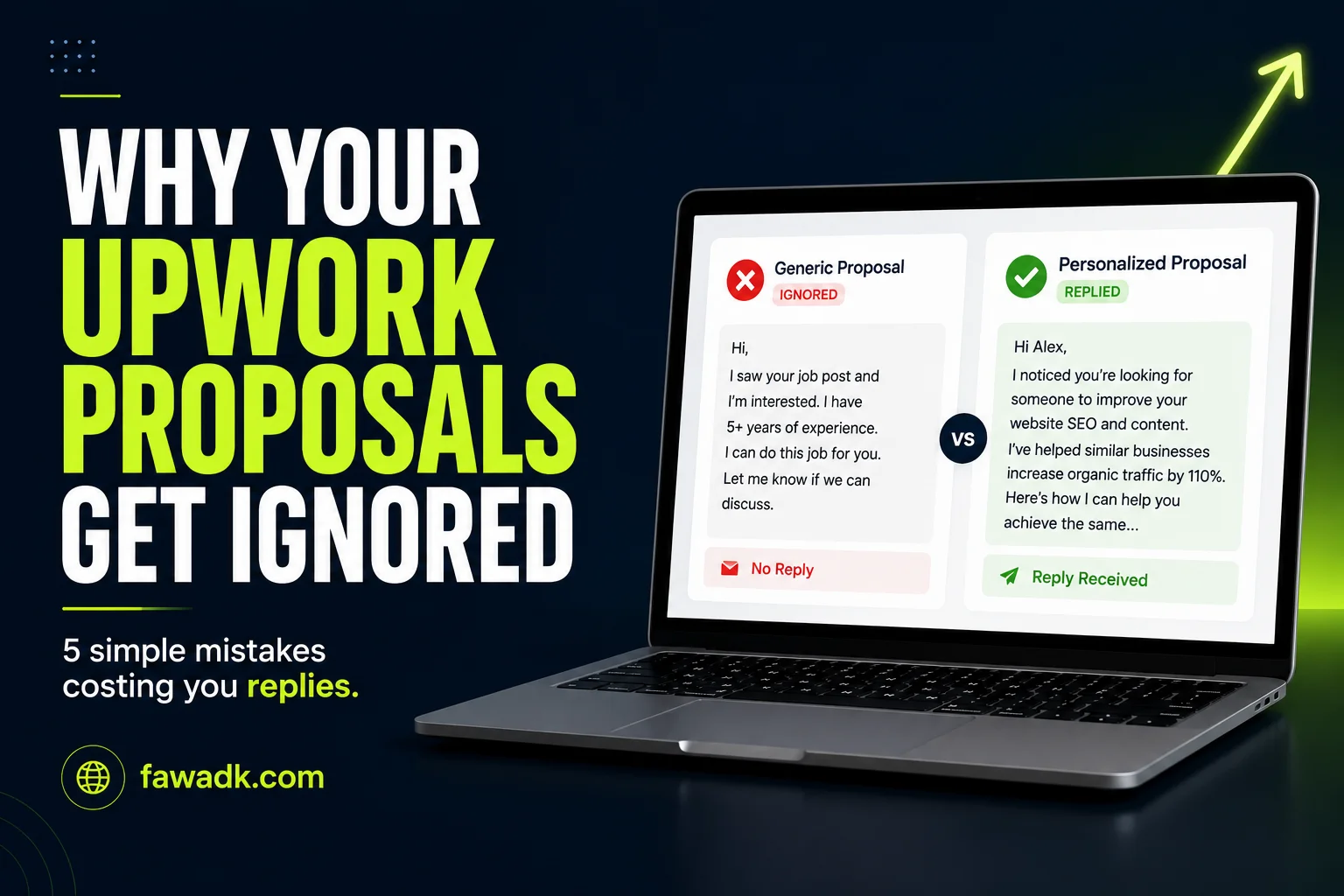
"Hi, I am a full stack developer with 6 years of experience. I have worked on many similar projects and I am confident I can deliver great results."
✓ What works
"Your checkout flow is likely losing mobile users at the payment step — I rebuilt the same flow for a Shopify brand last month and cut drop-off by 18%."
Most clients I work with on the proposal side make the same opening mistake — they write the first line about themselves before they've proven they read the job post at all. The client already has your profile, your rate, and your reviews visible. The proposal text is the one place to prove you understood the specific problem, and that's the one thing most proposals skip.
Here's the counterintuitive part: proposal length doesn't predict reply rate the way most freelancers assume. A three-paragraph proposal that opens with the client's problem outperforms a five-paragraph proposal that opens with a bio, even when the longer one has more relevant detail buried inside it. Clients stop reading before they reach the relevant part.
The second pattern is template reuse without adjustment. I can tell within the first sentence when a proposal was copy-pasted across ten different job posts — generic phrasing where a specific detail should be. Clients can tell too, often faster than freelancers think.
The fix: read the job post twice before writing anything. Find the one sentence that describes the client's actual problem — not the deliverable, the underlying problem. Open your proposal by naming that problem back to them in your own words. Everything else comes after.
03: The System
How I Approach Proposal Writing
This is the same structure I use when rewriting proposals for clients going through profile and pipeline work with me.
1: Read the job post for the problem, not the deliverable
Job posts usually describe what they want built, not what's actually wrong. "Need a landing page" is the deliverable. "Our current page converts at 1.2% and we don't know why" is the problem, if it's mentioned. If it's not mentioned, infer it from context — industry, stated goal, or what's missing from the post itself.
2: Open with the problem, named specifically
First line states the problem back to the client in language that proves you read the post — not generic industry language. This is the line that decides whether the rest gets read.
3: Reference one relevant piece of past work — with an outcome
4: Propose a first step, not the whole project
5: Ask one specific question
6: Cut anything that doesn't serve the first read
⚡ None of this requires more Connects spend. The proposals losing the most ground aren't losing because of competition — they're losing because the structure doesn't survive the first five seconds of a client's scan.
04: Real Example
Same Skills, Rewritten Proposal
📋Case: WordPress developer, 40+ proposals sent, 2 replies, JSS 95%
His proposals opened with "Hello, I am an experienced WordPress developer with 5+ years building custom websites for clients worldwide." Every proposal used the same opening paragraph, adjusted only for the service name. The job posts he was applying to had clear, specific problems stated — none of them were addressed in the first two lines.
We rewrote the structure, not the skill claims. New proposals opened with the client's stated problem in the freelancer's own words, followed by one relevant past result, then a proposed first step. Nothing about his actual development skill changed — the proposal just stopped hiding it behind a generic opening.
The reply rate moved before the JSS or the portfolio did. The structure was the only variable that changed.
12%
Old reply rate
31%
New reply rate
3 weeks
To see the shift
05: Comparison
Ignored vs. Read — At a Glance
❌ Gets Ignored
Opens with freelancer's background
Restates the job post requirements
Generic claim of relevant experience
Promises to deliver the full project
Ends with "let me know if interested"
Same template across every job post
✓ Gets a Reply
Opens with the client's specific problem
Responds to the underlying problem behind the post
One specific past result with a number
Proposes one concrete first step
Ends with one specific, answerable question
First two lines rewritten per job, every time
06: Advanced
What Most Proposal Advice Skips
⚡ Send timing affects visibility more than most freelancers account for. Job posts attract most of their proposal volume in the first few hours after posting. A proposal sent within that early window competes against fewer other proposals in the client's inbox — the same proposal sent a day later is buried under dozens more.
Connects spent on high-competition job posts with 20+ existing proposals rarely convert at the same rate as Connects spent on posts with fewer applicants and a clearly specific brief. Reply rate often drops as competition on a single post rises, independent of how strong the proposal itself is — the math of attention scarcity applies before the writing even matters.
Boosted Proposals can help on posts where you're a strong fit but arrived late, since they push your proposal back toward the top of the client's list. They don't fix a weak opening — boosting a generic proposal just gets the generic proposal seen sooner, not read longer.
🏅 The cover letter and the profile overview should not say the same thing. A proposal that repeats what's already on the profile gives the client no new information. The proposal's job is to apply the profile's general claims to this specific job post — that's the part templates can't do for you.
07: Watch Out For
Smaller Mistakes That Still Hurt
✗ Quoting a rate before answering the problem
Leading with price before establishing relevance reads as a freelancer optimizing for speed over fit. Address the problem first — the rate matters more once trust is established.
✗ Attaching a generic portfolio link with no context
A link with no explanation asks the client to do the interpretive work of finding the relevant piece. Name the specific project and the outcome in the text itself.
✗ Sending the same proposal to every job post in a saved search
Bulk-sending without adjusting the opening two lines is the single fastest way to burn Connects with no return. Each job post needs its own first line, even if the rest of the template stays similar.
✗ Ignoring stated budget or timeline constraints
If a job post states a budget or deadline and the proposal doesn't acknowledge it, the client reads that as not having read the post carefully. Confirm you can work within what's stated, or address it directly if you can't.
08: Conclusion